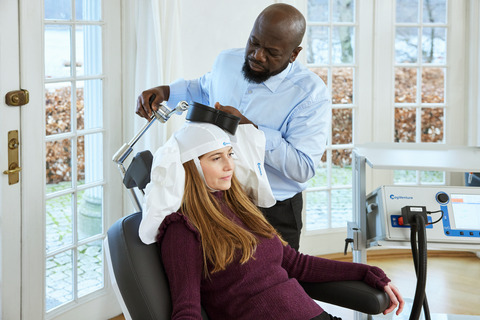
Bring New Hope to Adolescents With Treatment-Resistant Depression
FDA-cleared TMS for adolescents age 15+.
Approximately 30% of U.S. adolescents diagnosed with major depressive disorder (MDD) do not respond to standard treatments and meet criteria for treatment-resistant depression (TRD).*
Offer an FDA-cleared TMS solution for younger patients. MagVenture TMS systems are indicated as an adjunct treatment for Major Depressive Disorder in adolescents ages 15+, helping you support patients who need more than medication alone.
*Croarkin, P. E., & Ayvaci, E. R. (2023). Treatment-resistant depression in children and adolescents. Psychiatric Clinics of North America, 46(2), 359–370
What is Transcranial
Magnetic Stimulation (TMS)?
TMS is indicated for use in people with major depressive disorder who have not responded to at least one antidepressant medication. TMS has been recommended by the American Psychiatric Association since 2010.
TMS is non-invasive and does not require any anesthesia. Since there is no recovery period, people can return to their usual activities immediately.
TMS treatment takes approximately 3-18 minutes per treatment and typically requires sessions five days a week for a period of six weeks.

Why Psychiatrists Are Adding TMS for Adolescents
- Depression affects 1 in 5 adolescents, and medication non-adherence can reach up to 60%, underscoring the need for additional treatment options.1,2
- MagVenture TMS Therapy offers a noninvasive, well-tolerated adjunct treatment with minimal side effects and no recovery time.
- TMS provides superior outcomes in adolescents compared to older patients3
- ~20-minute sessions fit easily into adolescents’ schedules, with benefits observed to last up to six months4 alongside antidepressant therapy.
- More and more insurance payers are covering TMS for adolescents, helping practices expand access to care while generating predictable treatment-based revenue.
- March et al., 2007; Brent et al., 2008; Cipriani et al., 2016; Zhou et al., 2020.
- World Health Organization. (2024). Adolescent mental health.
- Zhang T et al., 2019
- Wall, et al., 2011, J. Clin. Psychiatry.

Get a Free Practice Consult
See how adolescent TMS can improve outcomes for your younger patients and grow your practice.
[No form? Accept Marketing cookies and try again.]